
It’s Not Just About Money—It’s About Direction
I still remember the day I had $1,000 sitting in my account and had absolutely no idea what to do with it. Part of me wanted to spend it. Another part knew that if I did, I’d have nothing to show for it a month later. That moment of hesitation — that pause before making a decision — turned out to be one of the most important financial moments of my life. It was also the moment I realised that investing for beginners is not really about the money itself. It’s about learning to think differently about it.
Because the truth is, $1,000 is not just money. It is a turning point. It is the moment you can shift from surviving to planning, from reacting to strategizing. And the biggest mistake most people make at that moment — especially when they’re just starting out — is not a lack of effort. It’s putting the money into the wrong place without any real plan. That’s the gap that investing for beginners content rarely addresses honestly.
I’ve seen it happen all around me. Hardworking people — friends, family members, neighbours — running small businesses that barely grow, or keeping their savings in accounts that quietly lose value to inflation year after year. The problem was never effort. It was always a strategy. So in this post, I want to share what I’ve learned, what I wish someone had told me earlier, and a practical guide to investing for beginners that shows you how to make your first $1,000 work far harder than you might think is possible.
The Economic Reality Every Investing for Beginners Guide Must Address
Let’s be honest about the world we’re investing in. Many economies are under serious pressure right now. Inflation has pushed up the cost of everyday essentials—food, fuel, rent—faster than most salaries have grown. Interest rates have risen, making borrowing more expensive. And keeping your money in a standard savings account, while it feels safe and responsible, is quietly eroding your purchasing power every single day.
I learned this the hard way. For almost two years, I kept money in a savings account thinking I was being responsible. And technically, I was—but in real terms, I was losing value. The balance stayed the same, but everything around me was getting more expensive. That “safe” money was actually shrinking in terms of what it could buy.
This is why investing is no longer a luxury reserved for the wealthy or the financially sophisticated. It is increasingly a necessity for anyone who wants to preserve and grow what they’ve worked hard to earn. And here’s the thing I want you to hold onto from the very beginning: investing is not gambling. It is a long-term strategy. Done right, it is one of the most reliable tools available to ordinary people.
Saving vs. Investing: A Distinction That Changed Everything for Me
Before I understood the difference between saving and investing, I made the classic mistake of treating them as the same thing. I’d save up a little money, then invest it, then panic when I needed emergency cash and pull it all out—often at exactly the wrong moment.
Saving is for the short term. It covers emergencies, upcoming expenses, and your day-to-day safety net. Investing is for the long term—it is about building wealth over years and decades, not months. The moment you blur that line is the moment investing becomes stressful instead of empowering.
One thing most investing for beginners resources skip over: before you invest a single dollar, make sure you can honestly say yes to all three of these:
- You have 3–6 months of living expenses saved in an accessible account
- Your essential needs—rent, food, utilities—are fully covered by your income
- You are genuinely prepared to leave your invested money untouched for at least 3–5 years
If you can’t check all three boxes yet, that’s okay—but focus on building that foundation first. Investing on a shaky base creates anxiety, not wealth.
What Investing for Beginners Actually Means
Investing simply means putting your money into something that has the potential to grow in value or generate income over time. That could be a business, financial assets like stocks and ETFs, or even skills and education. The key word is “potential”—no investment is guaranteed, and markets do go up and down. What history has shown us, consistently and across the globe, is that patient, diversified, long-term investing tends to reward those who stick with it.
When I first started on my investing for beginners journey, I was intimidated by the jargon—ETFs, indices, portfolios, and diversification. But over time, I realised it’s simpler than it sounds. You don’t need to be a financial expert to get started. You just need a clear plan, realistic expectations, and the discipline to stay the course when things feel uncertain.
Option 1: Start or Invest in a Small Business
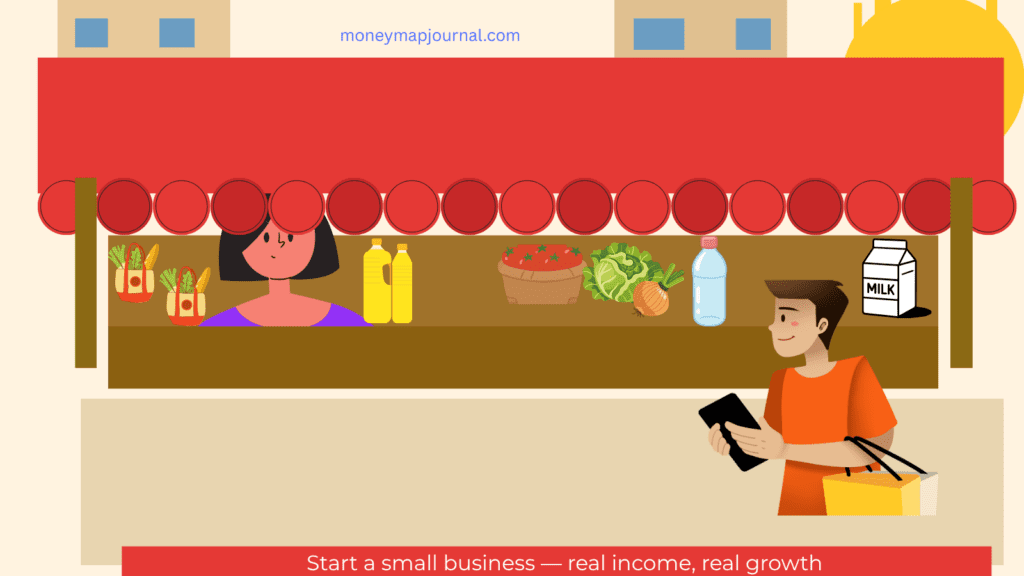
The first time I seriously considered starting a business with limited capital, someone told me: “You don’t need a lot of money to start. You need the right idea and the discipline to execute it.” That stuck with me. And it’s true.
Starting a small business with $1,000 is one of the most accessible paths to entrepreneurship available anywhere in the world. It demands more of your time and energy than other options, but it also offers some of the most immediate and tangible returns. You can see your money working in real time.
What works today
Small businesses that sell everyday essentials are particularly resilient. People need food, personal care, and basic services regardless of what the economy is doing. Businesses you can realistically launch with $1,000 include:
- A small retail shop selling fast-moving goods—flour, sugar, cooking oil, soap
- A barber shop with basic equipment
- A food stand or small takeaway
- A car wash or laundry service
These businesses generate daily cash flow—a critical advantage in economies where access to credit is limited and liquidity matters most. I know people personally who started with a single market stall and, within two years, had expanded into a small shop simply by reinvesting their profits consistently.
What most people get wrong
Here’s what I’ve observed—and experienced myself in an early venture that didn’t work out. Many small businesses fail not because the owner wasn’t working hard, but because there were no systems. The owner tries to do everything: serve customers, manage stock, handle money, market the business. Without structure, burnout and poor decisions follow quickly.
If you go this route, commit to these non-negotiables:
- Keep your personal and business finances completely separate from day one
- Track every coin of income and expense—even informally at first
- Choose your location thoughtfully; positioning often determines success more than the product itself
- Reinvest your early profits rather than spending them
- Understand the risks—theft, slow seasons, competition—and plan for them before they happen
This option is best for people who are hands-on, energetic, and ready to commit daily time and attention. The rewards can be significant, but so is the involvement required.
Option 2: Invest in Financial Markets
I’ll be honest: I was skeptical of financial markets for a long time. They felt abstract, distant, and—frankly—like something for people who already had a lot of money. Then I started reading more seriously, spoke to a few people who had been quietly growing their savings through index funds, and my perspective shifted completely.
The second path in any solid investing for beginners guide is financial markets — a quieter but genuinely powerful way to grow your money without showing up every day—but genuinely powerful—way to grow your money without showing up every day.
What this looks like in practice
With $1,000, you can invest in local stock exchanges, gain exposure to global companies, or purchase Exchange-Traded Funds (ETFs) that track entire sectors or economies—all from a smartphone app. To make it concrete: if you had invested $1,000 in a broad global market ETF ten years ago, it would be worth roughly $3,000–$4,000 today, depending on the fund—without you doing anything other than leaving it alone and occasionally adding more.
That number doesn’t happen overnight. But it does happen—and it happens because of compounding, which is simply the process of earning returns on your returns over time. The longer you stay in, the more powerful compounding becomes. Einstein reportedly called it the eighth wonder of the world. I don’t know if he actually said that, but after watching it work firsthand, I understand why people believe he did.
The mindset that separates successful investors from unsuccessful ones
In my experience, the difference between people who grow their investments and those who don’t comes down to three habits, not three strategies:
- They think in years, not months—and they don’t check their portfolio every day
- They don’t make emotional decisions when markets fall—and all markets fall sometimes
- They contribute consistently, adding small amounts over time even when it feels pointless
A Simple Investing for Beginners Strategy
Start by investing the bulk of your $1,000 across a small number of diversified ETFs. Add a fixed amount every month—even $20 or $30—and automate it if you can. Never try to “time the market” by waiting for the perfect moment. Studies consistently show that time in the market beats timing the market. Every time.
This approach suits people who prefer patience over pressure, and who want their money working in the background while they focus on other things.
Option 3: The Balanced Strategy—Business and Markets Together
After trying both approaches separately, I eventually landed on a combination of the two—and it’s what I’d recommend to most people who ask me. Rather than putting all your money in one place, you split it: for example, $600 into a small business and $400 into an ETF. This gives you income from two separate sources—monthly cash flow from the business, and long-term growth from your investment.
The real power here is resilience. If your business hits a slow month, your investment keeps growing. If the market dips, your business is still generating income. This is diversification in its most practical, everyday form.
To make it work, you need to commit to three things:
- Keep business and investment money strictly separate—never mix the two
- Stay consistent with both streams, even when one is underperforming
- Never use your investment funds to solve a business cash flow problem
This option is ideal for people who want both control and security, and who have the discipline to manage two financial commitments simultaneously.
My Final Thought: The Investing for Beginners Mindset That Changes Everything
If I could go back and give my younger self one piece of advice about that $1,000 sitting in my account, it would be this: stop waiting for the perfect moment and start with a plan, however imperfect.
There is no universal right answer, and no investing for beginners guide should pretend otherwise. The best option depends on your personality, your circumstances, and what you’re genuinely willing to commit to. If you love hands-on work and have the energy to run something daily, start a business. If you prefer patience and simplicity, invest in the markets. If you want both income and growth, combine them. What matters far more than which option you choose is that you actually choose—and then stay consistent.
The earlier you start, the more time compounding has to work in your favour. But “earlier” doesn’t mean recklessly. It means building a stable foundation first, then making intentional decisions with whatever you have available.
If you have $1,000 right now, here’s your action plan:
- Build your emergency fund first—aim for 3–6 months of living expenses
- Choose the option that genuinely fits your personality and lifestyle
- Start small, but start today
- Track your progress monthly and adjust as you learn
- Stay consistent—wealth is built over years, not weeks
Your $1,000 is a decision, not just a deposit. Make it count.