
Discover the wealth habits that actually move the needle — practical, honest, and built for real people starting from zero.

Monthly budget planner — every shilling has a job
I Had a Good Income and Nothing to Show for It
The habits to build wealth aren’t complicated — but most people never learn them.
For a while, I thought I was doing okay.
I had a salary coming in every month. I wasn’t skipping meals. I could cover my bills. By most measures, I was fine. But every time I checked my bank account a week before payday, there was almost nothing there. I wasn’t broke in the dramatic sense — I was just quietly, consistently running on empty.
The frustrating part? I couldn’t tell you where the money went. It just… went.
It took me longer than I’d like to admit to realise the problem wasn’t my income. It was my habits. The small, daily decisions I was making, the habits to build wealth or destroy it, were quietly cancelling out every shilling I earned.
When I finally changed those habits, everything shifted. Not overnight. But steadily, month by month, the numbers started moving in the right direction.
That’s what this article is about. Not get-rich-quick schemes. Not investment tips that require you to already have money. These are the seven habits to build wealth I’ve seen— and lived — that separate people who build real wealth from those who stay stuck, no matter how much they earn.
Habit 1: They Decide What Happens to Their Money Before the Month Starts
One of the core habits to build wealth is deciding where your money goes before you spend it. They tell it where to go — before they spend a single coin.
This is the core idea behind zero-based budgeting: every shilling of your income gets assigned a job before the month begins. Rent. Groceries. Savings. Investments. Entertainment. Everything gets a slot. When the money runs out in a category, it’s done.
The people I know who’ve built wealth from ordinary incomes all have one thing in common — they treat their budget like a non-negotiable appointment. Not a wish list. A plan.
📌 What to do: Before the 1st of every month, sit down and write out your income and every expected expense. Assign every shilling. If you’ve never done this, it will feel uncomfortable the first time. That discomfort is the habit forming.
Habit 2: They Pay Themselves First — Without Negotiating
Most people save whatever is left at the end of the month. Wealth builders save first and live on what remains.
It sounds simple. It changes everything. Paying yourself first is one of the simplest habits to build wealth that anyone can start today.
When you save last, life always has a reason why this month is different. The car needed something. A friend had a wedding. The kids needed school supplies. There is always a reason. And so the savings never happen.
When you save first — even 10% of your income transferred the same day your salary arrives — you force yourself to adjust to what remains. You still pay your bills. You still eat. But you stop treating savings as optional.
📌 What to do: Set up an automatic transfer to a separate savings account on the day you receive your income. Even KSh 2,000 or $50 a month. The amount matters less than the consistency of the habit.
Habit 3: They Know Their Numbers — All of Them
Ask someone who is quietly building wealth what their net worth is and they’ll tell you. Ask someone who is stuck and they’ll look uncomfortable and change the subject.
Wealth builders track their numbers the way athletes track their performance. Monthly income. Monthly expenses. Total savings. Total debt. Net worth. These aren’t scary figures to avoid — they’re the scoreboard.
You cannot improve what you refuse to measure — and measuring is one of the non-negotiable habits to build wealth.
I used to avoid checking my full financial picture because I was afraid of what I’d see. The moment I started facing the numbers honestly — even the embarrassing ones — was the moment I could actually start fixing them.
📌 What to do: Once a month, write down your total assets (what you own) and your total liabilities (what you owe). Subtract one from the other. That’s your net worth. Track it every month. Watch the direction it moves.
Habit 4: They Spend Less Than They Earn — By Design, Not Accident
This is the most basic of all habits to build wealth — and the most violated one
It’s not enough to earn more. Lifestyle inflation — the tendency to upgrade your spending every time your income rises — quietly erases every raise, every promotion, every side hustle win.
Wealth builders create a permanent gap between what they earn and what they spend. That gap is where wealth lives. Everything that goes into that gap — savings, investments, debt repayment — is building something. Everything that closes the gap is just noise.
This doesn’t mean living like a monk. It means being intentional about which upgrades actually improve your life and which ones are just keeping up with appearances.
📌 What to do: Every time your income increases, resist the urge to immediately increase your lifestyle. Direct at least half of every raise or windfall straight to savings or investments before adjusting your spending.

Why your income rise doesn’t always mean wealth — lifestyle inflation vs. the wealth gap
Habit 5: They Start Investing Early — Even When the Amount Feels Embarrassing
There is a lie that stops a lot of people from investing: I’ll start when I have more money.
More money rarely comes before the habit. The habit is what creates more money.
Wealth builders understand compound interest — the mathematical reality that money invested early grows exponentially over time. Starting with $100 a month at 25 beats starting with $500 a month at 40. Not because of discipline or intelligence, but because of time.
The goal at the beginning isn’t to invest a lot. It’s to start the habit, learn how it works, and let time do the heavy lifting.
📌 What to do: Open a brokerage account or investment account and make one contribution this month — even a small one. The size doesn’t matter yet. Starting matters. (See our full guide: Investing for Beginners: What to Do With Your First $1,000.)
Habit 6: They Protect What They Build
Building wealth without protecting it is like filling a bucket with a hole in the bottom.
People who build lasting wealth are intentional about protection. This means an emergency fund — 3 to 6 months of expenses kept in a separate, accessible account — so that a job loss, medical bill, or broken car doesn’t force them to raid their investments or take on debt.
It also means insurance — health, life if you have dependants, and eventually income protection. Not because bad things will definitely happen, but because wealth built without protection can disappear in a single crisis.
📌 What to do: Before you invest aggressively, build a starter emergency fund of at least one month’s expenses. Then grow it. This is your financial shock absorber.
Habit 7: They Stay Consistent When Results Are Invisible
This is the habit that separates people who eventually build wealth from those who try and quit.
The early months of building good financial habits are unrewarding. Your savings are small. Your investments aren’t doing much yet. Nothing looks impressive. It’s easy to wonder whether it’s worth it.
Wealth builders stay the course through this invisible phase. They understand that financial progress is not linear — it’s slow at the start and then, with time and compound growth, it accelerates dramatically.
The people who master habits to build wealth aren’t always the most talented or highest earners. They are almost always the most consistent.
📌 What to do: Set a simple monthly habit tracker — five lines, one for each key habit. Budget done. Savings transferred. Numbers checked. Expenses reviewed. Investment contribution made. Tick them off. On the hard months, the tick marks are your motivation.
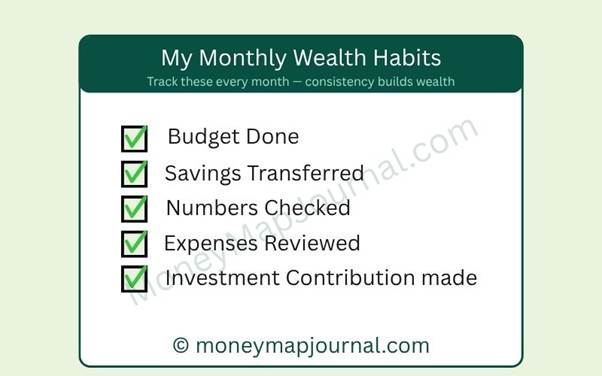
My Monthly Wealth Habits — track every month to build consistency
The Habits Come First. The Wealth Follows.
Nobody builds wealth by accident. But you also don’t need to be exceptional to do it.
You need a budget you actually follow. A savings habit you don’t negotiate out of. The courage to look at your numbers honestly. A gap between what you earn and what you spend. An investment account you contribute to consistently. Protection for what you build. And the patience to stay consistent when nothing looks impressive yet.
These habits to build wealth aren’t secrets. And habits are things you can start today — regardless of your income, your past mistakes, or where you’re starting from.
If you’re ready to start, begin with Habit 1. Download our free budget template and build your first zero-based budget this month.
© moneymapjournal.com — Free for personal use