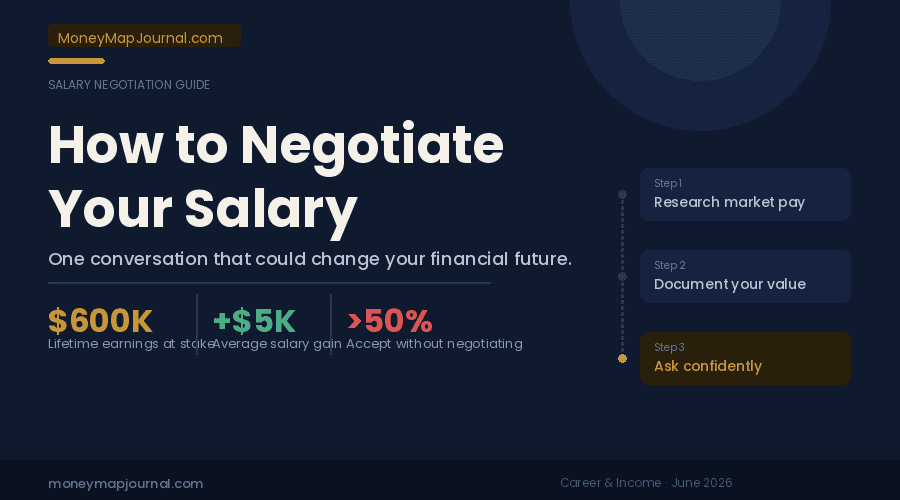
One conversation could be worth $600,000 over your career. Here’s exactly how to have it — and win.

You’ve done the interviews. You’ve nailed every question. And now — finally — there’s an offer on the table. Most people breathe a sigh of relief and accept it. The smartest people pause, take a breath, and negotiate. That single pause could be worth hundreds of thousands of dollars over the course of your career. Learning how to negotiate your salary is one of the most important financial skills you’ll ever develop.
In This Article
1. Why Salary Negotiation Is the Best Financial Decision You’ll Ever Make
2. The Numbers Don’t Lie: What Not Negotiating Really Costs You
3. How to Prepare: Research, Value, and Practice
4. 5 Proven Salary Negotiation Strategies
5. What to Actually Say: Scripts That Work
6. Beyond Base Salary: Negotiating Total Compensation
7. 7 Mistakes to Avoid When Negotiating
8. Negotiating a Raise in Your Current Job
9. Frequently Asked Questions
1. Why Salary Negotiation Is the Best Financial Decision You’ll Ever Make
Here is a truth most people never learn until it’s too late: your salary isn’t just a paycheck — it’s the foundation of your entire financial life. Everything you want to accomplish financially — paying off debt, building an emergency fund, investing for retirement, buying a home, building generational wealth — depends on the income you bring in each month. That is why knowing how to negotiate your salary is one of the most powerful financial skills you can develop.
Yet surveys consistently show that more than half of workers accept job offers without negotiating a single dollar. The reasons are understandable: fear of rejection, discomfort with confrontation, worry about losing the offer entirely. But these fears are, in almost every case, overblown — and the cost of not knowing how to negotiate your salary is enormous.
According to research by New York Life, failing to negotiate your salary could cost you as much as $600,000 in lifetime earnings. That figure sounds dramatic, but it makes perfect mathematical sense: every future raise, bonus, and retirement contribution is typically calculated as a percentage of your base salary. If your base is too low, every financial milestone that follows is lower too.

| RELATED READING ON MONEYMAPJOURNAL.COM |
| → How to Build a 6-Month Emergency Fund |
| → The 50/30/20 Budgeting Rule: A Beginner’s Guide |
| → 10 Passive Income Ideas to Supplement Your Salary |
2. The Numbers Don’t Lie: What Not Negotiating Really Costs You
Let’s make this concrete. Imagine two candidates — Alex and Jordan — who both receive the same job offer: $60,000. Alex accepts on the spot. Jordan negotiates and lands $65,000. Just a $5,000 difference. Fast-forward ten years, with both receiving identical 3% annual raises:
- Alex’s year-10 salary: approximately $80,635
- Jordan’s year-10 salary: approximately $87,345
- Jordan’s cumulative 10-year earnings advantage: over $70,000
- Once 401(k) contributions (often matched as a % of salary) are factored in, the advantage grows further.
| “Your earning potential is probably the single largest asset you will ever have. Negotiating — especially early in your career — is absolutely critical.” — New York Life, Salary Negotiation Guide | newyorklife.com |
This compounding effect is precisely why learning how to negotiate your salary is not just a short-term win — it is a long-term financial strategy and one of the highest-return actions you can take with a single hour of preparation. For more on making your money work harder, read our guide at moneymapjournal.com/investing-your-raise.
3. How to Negotiate Your Salary: Research, Value, and Practice
Confidence in any negotiation comes from preparation. Walking into a salary discussion without data is like going to court without evidence. The good news: gathering what you need to negotiate salary effectively takes just a few hours. Use this checklist every time you need to negotiate salary for a new role or a raise:
Step 1 — Research Market Salaries
You need to know what the market pays for your role, experience level, and location before you say a single number. Use multiple sources to build a reliable range:
- Glassdoor — real salary data from verified employees
- Payscale — personalised salary reports by skills and location
- Bureau of Labor Statistics — official U.S. government occupational data
Don’t rely on a single figure. Build a range (e.g., $72,000–$88,000) so you can anchor high and still have room to land where you need to be. Also note that salaries vary dramatically by geography — always filter by your city or region.

Step 2 — Document Your Unique Value
Employers don’t increase salaries because you need the money — they do it because you bring value they’d struggle to find elsewhere. Make a specific list of your contributions:
- Revenue you’ve generated or costs you’ve reduced (with dollar figures where possible)
- Leadership roles, certifications, or specialised expertise
- Projects you led that hit or exceeded goals
- Skills that would be expensive for them to hire for on the open market
| ■ Pro Tip: Know Your Two Numbers Before any negotiation, establish two figures in your mind: your TARGET SALARY (what you ideally want) and your WALK-AWAY NUMBER (the minimum you’ll accept). Never reveal your walk-away number — and be prepared to actually walk away if the offer falls below it. |
Step 3 — Practice Out Loud
Reading about negotiation is not the same as doing it. Write out your pitch, then say it out loud — ideally in a mock session with a friend, mentor, or career advisor. The goal is to sound confident and natural. The discomfort you feel when practising is exactly the discomfort you want to eliminate before the real conversation.
4. Five Proven Strategies to Negotiate Your Salary
Research from the Harvard Program on Negotiation and a Journal of Organizational Behavior study found that the strategy you choose when you negotiate your salary matters more than almost any other factor. Here are the five strategies you need to know:
1. Use the Anchoring Technique
The first number stated in a negotiation has an outsized influence on where things land — this is called the anchoring effect. When you negotiate your salary, name a range higher than your target. Instead of saying “I was hoping for $80,000,” say: “Based on my research, professionals in this role typically earn $85,000 to $95,000.” Even if the employer pushes back, you’ve moved the anchor in your favour.
2. Collaborate, Don’t Confront
Frame negotiation as a problem to solve together. The Harvard study found that candidates who used a collaborative approach were more satisfied with outcomes and maintained better relationships. Say: “I want us to reach a number that reflects both my value to the team and the market standard.”
3. Time It Perfectly
The best moment to negotiate is after receiving a written offer, before signing anything. At this point, the employer has decided you are their top candidate — you have maximum leverage. Raising salary during the interview process weakens your position significantly.
4. Aim High and Work Down
Request a figure near the top of the range you’ve identified. Employers rarely give you more than you ask for, but will often meet you in the middle. Starting high gives room to land where you want to be, even after pushback.
5. Ask Strategic Questions
If the employer says the salary is fixed, ask: “What skills would put someone at the top of this salary range?” or “Is there flexibility reviewing my salary at the 6-month mark?” These questions reframe the conversation and reveal new opportunities to negotiate toward.
5. What to Actually Say: Scripts That Work
Knowing the strategy is one thing. Knowing the exact words to use when you negotiate salary is another. The scripts below show you precisely how to negotiate salary in the most common situations you’ll encounter. Here are battle-tested scripts you can adapt to your situation:
| When You Receive an Offer That’s Too Low “Thank you so much for the offer — I’m genuinely excited about this opportunity and the team. I’ve done some research on the market rate for this role, and based on my experience, I was hoping we could get closer to $[Target]. Is there flexibility there?” |
| When the Employer Pushes Back “I completely understand, and I appreciate your transparency. I’m very motivated to join the team. If the base salary isn’t flexible right now, could we explore a signing bonus, an earlier performance review, or additional PTO? I want to make this work.” |
| When Negotiating a Raise in a Current Role “I wanted to set up some time to discuss my compensation. Over the past [X] months, I’ve [achieved result / led project / grown responsibility]. Based on current market data, I believe a salary of $[Amount] better reflects my contributions. I’d love to discuss how we can get there.” |
6. Beyond Base Salary: Negotiating Total Compensation
If an employer says the base salary is truly non-negotiable, the conversation isn’t over — it’s just shifting. When you negotiate your salary, remember that total compensation includes a wide range of benefits that can be just as valuable as a higher paycheck, sometimes more so.

- Signing Bonus — one-time payment that doesn’t raise the salary budget line; easier for employers to say yes
- Additional Vacation Days — even 5 extra days per year has real monetary and quality-of-life value
- Remote Work Flexibility — eliminating a commute can save thousands per year in transport costs
- Professional Development Stipend — funding for certifications that improve your long-term earning power
- Equity / Stock Options — particularly valuable at startups where upside potential can be significant
- 401(k) Matching — maximise employer contributions; this is literally free retirement money
- Earlier Performance Review — request a 6-month review instead of 12 if salary can’t budge today
- Relocation Assistance — if you’re moving for the role, push for a one-time relocation allowance
| ■ Think Total Compensation, Not Just Salary A $5,000 signing bonus, 5 extra vacation days, and a $2,000 training stipend can easily be worth more than a $5,000 salary increase — especially once you factor in tax treatment and long-term impact. Always evaluate the complete package. |
7. Seven Mistakes to Avoid When Negotiating Your Salary
Even well-prepared candidates sabotage their own attempts to negotiate salary. Knowing how to negotiate salary is only half the battle — avoiding these common errors is the other half. Here are the most common pitfalls and how to sidestep them:
1. Bringing Up Personal Financial Needs
Employers don’t pay based on your expenses — they pay based on your value. Always frame the conversation around market data and contributions, not your rent or student loans.
2. Accepting the First Offer Immediately
Even if the offer exceeds your expectations, pausing to review it signals professionalism and gives you a chance to consider whether there’s room to improve total compensation.
3. Negotiating Against Yourself Before It Starts
Harvard researchers call this “getting in your own way.” Many candidates talk themselves out of asking for more before they’ve even opened their mouth. These internal concessions are just as real.
4. Giving a Range When Asked for a Number
If you say “$70,000 to $80,000,” the employer hears “$70,000.” Make sure even the bottom of your range is acceptable to you — or anchor with a specific number and the reasoning behind it.
5. Making It Confrontational
Negotiation is collaborative problem-solving, not a battle. You can be firm, direct, and assertive while remaining warm and professional throughout.
6. Not Getting the Final Offer in Writing
Any salary discussion — especially involving bonuses or equity — should be confirmed in writing before you give your final acceptance. Verbal agreements don’t protect you.
7. Forgetting to Negotiate at All
The single costliest mistake. Employers expect candidates to negotiate your salary, and most have room to move. By not asking, you leave money on the table that was already there for the taking.
8. Negotiating a Raise in Your Current Job
Knowing how to negotiate your salary isn’t just for new job offers. If you’re already employed, asking for a raise — done right — is equally powerful. The same principles apply: market data, documented value, and professional framing. Here’s how to time it and what to bring:
When to Ask
The ideal moments to request a raise are during your annual performance review, shortly after a major accomplishment, or when you’ve taken on significantly more responsibility. Avoid asking during budget freezes, company layoffs, or right after a public setback.
What to Bring to the Conversation
- A written summary of your accomplishments since your last review
- Market salary data showing what your role pays externally
- Evidence that your responsibilities have grown beyond your original job description
- A specific target number — not a vague request for “a raise”
| RELATED READING ON MONEYMAPJOURNAL.COM |
| → Got a Raise? Here’s Exactly What to Do With the Extra Money |
9. Frequently Asked Questions About Salary Negotiation
Q: Is it rude to negotiate a salary offer?
Not at all. Learning how to negotiate salary is a professional skill, not an act of aggression. Most hiring managers expect you to negotiate your salary, and doing so professionally signals confidence and business savvy. A Harvard PON study found that candidates who negotiated assertively were seen as more competent, not more demanding.
Q: What if the employer says the salary is non-negotiable?
“Non-negotiable” usually means the base salary is fixed — not the entire compensation package. Even so, you can still negotiate salary in other ways: signing bonuses, remote work options, additional PTO, or an earlier performance review. There is almost always something that can move when you know how to negotiate salary effectively.
Q: Should I reveal my current salary?
You are not obligated to share your current salary, and in many U.S. states it is illegal for employers to ask. The goal when you negotiate salary is to anchor the conversation to market value, not past compensation. If pressed, redirect: “I’d prefer to focus on the value I bring and the market range for this role.”
Q: How do I negotiate salary over email?
You can negotiate your salary over email using the same principles: be grateful, specific, and professional. State your target number, provide brief evidence, and invite a conversation. Keep it brief, professional, and specific about your number.
Q: When is the best time to bring up salary?
The best time to negotiate salary is after a formal offer has been made — this is when your leverage is highest. If an employer asks earlier, say: “I’d love to learn more about the full scope of the role before discussing numbers — I want to make sure we’re aligned on responsibilities first.”
The Bottom Line: Your Worth Is Worth Asking For
Learning how to negotiate your salary is not about being greedy or aggressive. It is about recognising that you have done the work, you bring real value, and the market has a price for that value — and you deserve to be paid it.
The research is overwhelming: people who understand how to negotiate salary and act on it earn more, feel more satisfied in their roles, and build faster financial momentum over their careers. The short-term discomfort of one 15-minute conversation is nothing compared to the decades of compounding financial advantage it unlocks.
So prepare your data. Know your value. Practice your script. And when that offer comes — pause, breathe, and ask for what you’re worth.
| “Negotiating your salary is not simply about asking for more money. It’s about recognising and advocating for your worth — and positioning yourself for long-term financial security.” — Vermont Federal Credit Union | vermontfederal.org |