
Choosing between debt snowball vs avalanche is one of the biggest decisions you will make once you decide to get serious about paying off debt. Both methods work, but they work in different ways and for different kinds of people.
About two years ago I found myself sitting at my kitchen table, looking at four credit card statements spread before me. The numbers I saw were more than I wanted to see, and all those finance blogs suggested totally different ways to deal with it. One blog said to pay off the smallest balance first because it would give me psychological satisfaction. Another blog said to start with the highest interest rate to save money. I did both at some point, but what I realized is that the approach that worked for me was not necessarily the mathematically best way to do it.
I started to use the debt snowball approach when I paid off the smallest card and made minimum payments to the other three. And what I got from it was a great feeling from seeing that zero number on my statement. But later, when I realized what I can achieve, I decided to change my tactics and used the debt avalanche approach to eliminate a card with the high interest rate. Neither method in the debt snowball vs avalanche debate is better than the other. The thing is to understand them and their cost and choose the one that will suit your mindset.
That kitchen table moment is the reason this guide exists. Below you will find a plain language breakdown of debt snowball vs avalanche, a side by side comparison, a real example with numbers, and a simple way to decide which one fits your life right now.
What Is the Debt Snowball Method
The debt snowball method asks you to list every debt you owe from the smallest balance to the largest, no matter what interest rate each one carries. You pay the minimum on every debt except the smallest one. On that smallest debt you throw every extra dollar you can find until it hits zero. Once it is gone, you take the full amount you were paying on it and add that to the minimum payment on the next smallest debt. The payment keeps growing as you clear each balance, which is where the name comes from.
People who use this side of the debt snowball vs avalanche choice often say the biggest benefit is not financial at all. It is the feeling of crossing a debt off the list completely. That first zero balance can be the difference between giving up on a payoff plan and sticking with it for years.
What Is the Debt Avalanche Method
The debt avalanche method also starts with a list of every debt you owe, but this time you order them by interest rate instead of balance, from highest to lowest. You still pay the minimum on everything except the top debt on the list. Every spare dollar goes toward the debt charging you the most in interest. Once that one is paid off, you roll the payment into the debt with the next highest rate, and so on down the list.
Because you are attacking your most expensive debt first, this side of debt snowball vs avalanche usually saves you the most money over the life of your payoff plan. The tradeoff is that your first target might also be your largest balance, which can mean waiting longer for that first win.
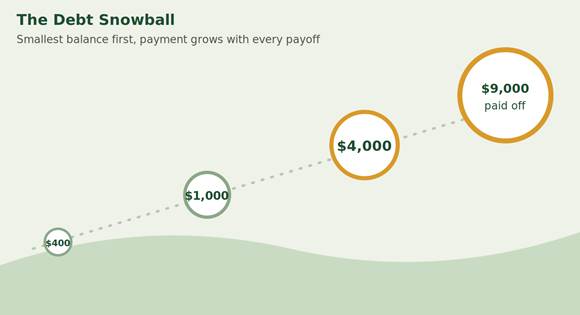
The debt snowball method in the debt snowball vs avalanche comparison, showing how the payoff amount grows as each smaller balance is cleared.
Debt Snowball vs Avalanche, A Side by Side Comparison
Here is how debt snowball vs avalanche stack up against each other once you put them side by side.
Debt snowball vs avalanche, quick comparison
| Feature | Debt Snowball | Debt Avalanche |
| Payoff order | Smallest balance first | Highest interest rate first |
| Motivation style | Quick, frequent wins | Fewer wins, bigger payoff at the end |
| Total interest paid | Usually higher | Usually lower |
| Time to first win | Fast | Can be slow if your highest rate debt has a large balance |
| Best suited for | People who need visible progress to stay committed | People who are comfortable waiting for the biggest savings |
A Real Example, Debt Snowball vs Avalanche in Action
Numbers make debt snowball vs avalanche easier to picture. Say you owe money on three cards with the balances and rates below.
Sample debt list used for the snowball and avalanche order
| Debt | Balance | Interest Rate | Snowball Order | Avalanche Order |
| Card A | $1,000 | 22 percent | 1st | 2nd |
| Card B | $4,000 | 18 percent | 2nd | 3rd |
| Card C | $9,000 | 24 percent | 3rd | 1st |
With the debt snowball method, Card A gets every spare dollar first because it has the smallest balance, even though Card C has a higher rate. With the debt avalanche method, Card C gets attacked first because it charges the most interest, even though it carries the largest balance. Both plans end with all three cards paid off. The avalanche plan generally costs less in total interest, while the snowball plan generally delivers your first zero balance sooner.
Before you accelerate payments toward either method, most debt payoff guidance from the FTC recommends having a written budget so you know exactly how much extra you can safely put toward debt each month. If you have not built one yet, our guide on how to build a monthly budget walks through the zero based method step by step.
Which Method Should You Choose
If you have tried to pay off debt before and lost steam halfway through, the debt snowball method is worth considering. The quick wins keep motivation high, and staying consistent matters more than shaving off a few extra dollars in interest. Credit counselors at the NFCC often point out that the plan you actually finish beats the plan that only looks better on paper.
If you are disciplined about sticking with a plan and your main goal is to spend as little as possible on interest, the debt avalanche method is the stronger choice. Fidelity notes that the avalanche approach tends to save the most when your debts carry a wide range of interest rates, since you knock out the most expensive one first.
Some people land on a hybrid version of debt snowball vs avalanche. They start with the debt snowball to build momentum, clear a card or two, then switch to the debt avalanche once they feel confident the plan will stick. That was close to my own path, and there is nothing wrong with borrowing the best of both.
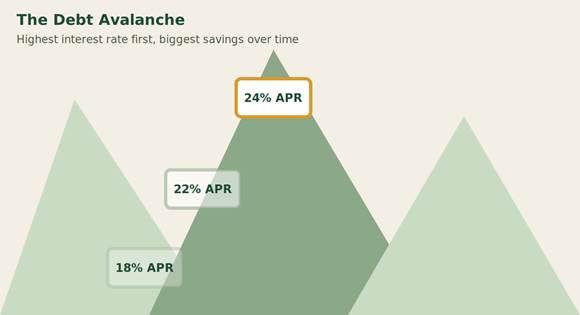
The debt avalanche method in the debt snowball vs avalanche comparison, showing the highest interest rate debt targeted first.
How to Get Started Today
- List every debt you owe along with its balance and interest rate in one place, on paper or in a simple spreadsheet.
- Choose your order. Smallest balance first for the debt snowball, or highest interest rate first for the debt avalanche.
- Set your minimum payments on autopay so nothing slips through the cracks while you focus on your target debt.
- Send every extra dollar you can find toward the top debt on your list until it reaches zero.
- Roll the full payment amount into the next debt on your list and repeat until you are debt free.
Whichever order you choose, the extra money you put toward debt each month matters more than the method itself. In my own payoff, the biggest jump did not come from picking debt snowball vs avalanche correctly, it came from finding an extra $180 a month after I canceled two subscriptions I had forgotten about and started meal planning instead of ordering takeout on tired weeknights. That single change shaved almost a year off my timeline, which taught me that the method you choose only works as well as the amount of extra money you feed it. If your budget feels too tight to free up anything extra, start with our guide on how to save money on a tight budget or how to stop living paycheck to paycheck to find room in your numbers first.
It also helps to have a small buffer set aside before you go all in on either method, so one unexpected bill does not send you back to your credit card. Our emergency fund guide covers how much to keep on hand and where to keep it. And if you want a ready made spreadsheet to track your payoff progress, our free budget templates are a good place to start. For more general tips on tackling what you owe, Experian’s debt payoff guide and the Wells Fargo comparison of both methods are worth a read as well. Looking back, I wish someone had pushed me to build that buffer before I threw every spare dollar at my cards. About four months into my own debt snowball vs avalanche plan, my car needed a new alternator, and because I had no cushion set aside, I ended up putting the repair right back on the credit card I had just paid down to zero. It was not a huge setback, but it was a frustrating one, and it taught me that a small emergency fund is not a distraction from your debt payoff plan, it is part of what makes the plan hold up when life does not cooperate.
There is no wrong answer in the debt snowball vs avalanche debate. The method that gets your debt to zero is the one you actually stick with, whichever list order gets you there. Looking back at my own four credit cards, what actually mattered was not which list order I picked first, it was that I kept showing up every month, even on the months when progress felt slow. If you are still weighing debt snowball vs avalanche, my honest advice is to stop overthinking the math and start with whichever one gets you to make your first extra payment this week, because momentum, not the perfect formula, is what actually pays off debt.