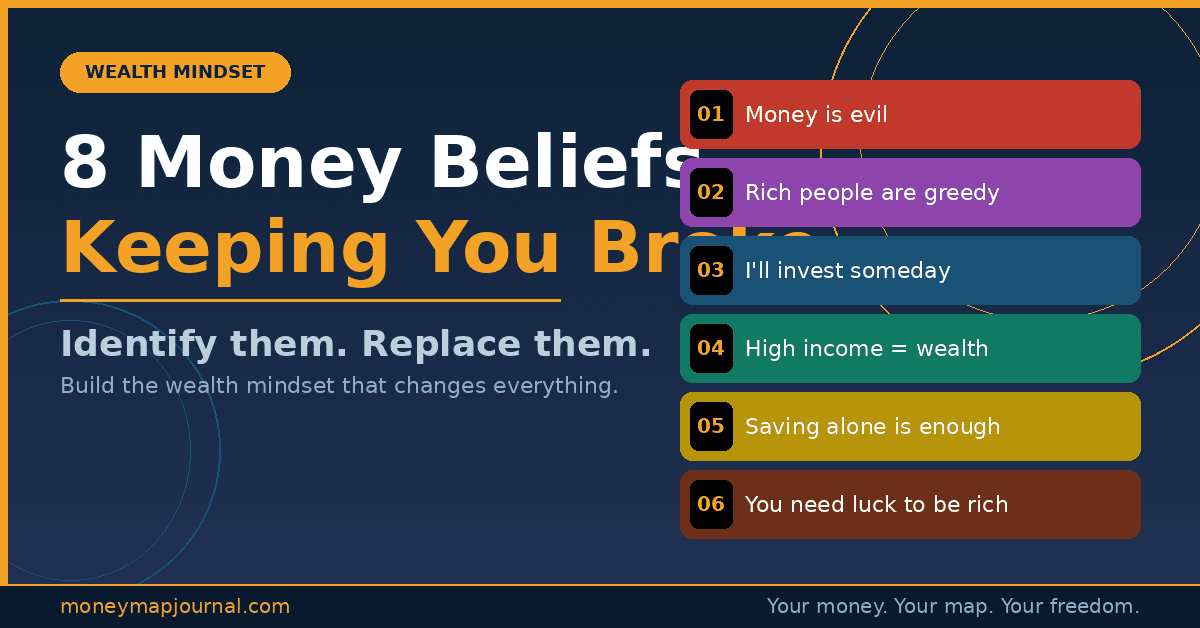

moneymapjournal.com | The Wealth Mindset — Break the cycle, build the life.
I have a confession to make. For years, I carried beliefs about money that quietly held me back — not because I was lazy or unambitious, but because nobody ever told me these beliefs were wrong. I thought rich people were lucky. I thought wanting money was somehow greedy. I thought if I just worked hard enough and saved every coin, wealth would eventually show up.
It did not. And I had to do some serious unlearning before things began to change.
The truth is, most people are not broke because they lack intelligence or opportunity. They are broke because of what they believe about money. Your beliefs form the lens through which you see every financial decision, every risk, every opportunity. If those beliefs are distorted, even the best strategies will not save you.
In this article, I want to walk you through 8 specific money beliefs that are quietly keeping millions of people broke — and more importantly, how to replace each one with a wealth mindset that actually works. Whether you are just starting out or rebuilding, these shifts can change the game entirely.
“It is not your salary that makes you rich — it is your spending habits, your beliefs, and your decisions.” — Charles A. Jaffe
Understanding the Wealth Mindset: Scarcity vs. Abundance
Before we get into the beliefs themselves, let’s establish a foundation. There are two dominant ways people relate to money: a scarcity mindset and an abundance mindset. Most of us were raised in a scarcity environment — where money was tight, talked about in hushed tones, or framed as something dangerous.
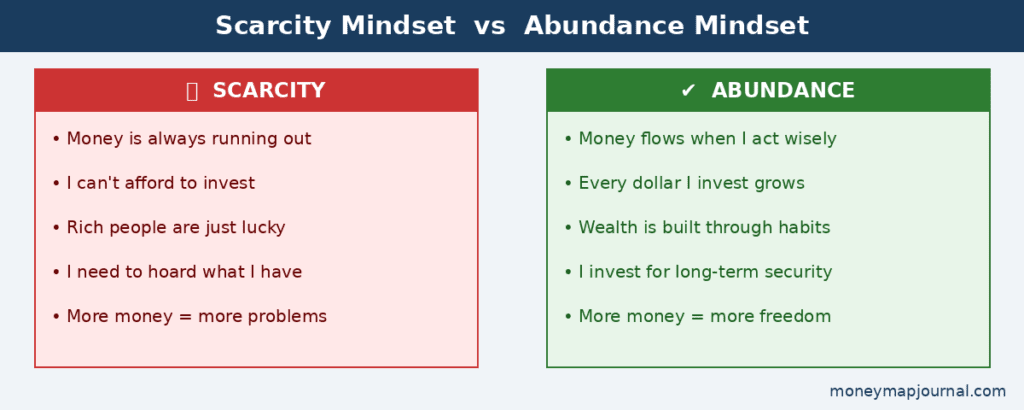
moneymapjournal.com | Scarcity vs. Abundance Mindset — which one is running your finances?
Scarcity thinking says: “There is never enough.” It causes hoarding, fear-based decisions, and paralysis. Abundance thinking says: “With the right moves, resources can grow.” It encourages strategic planning, investment, and long-term vision.
The good news? You can shift from scarcity to abundance — but first, you need to identify the specific beliefs that are anchoring you to the wrong side. I’ve also written about the practical steps involved in building wealth from scratch, which ties closely to everything we’ll cover here.
The 8 Money Beliefs That Are Keeping You Broke
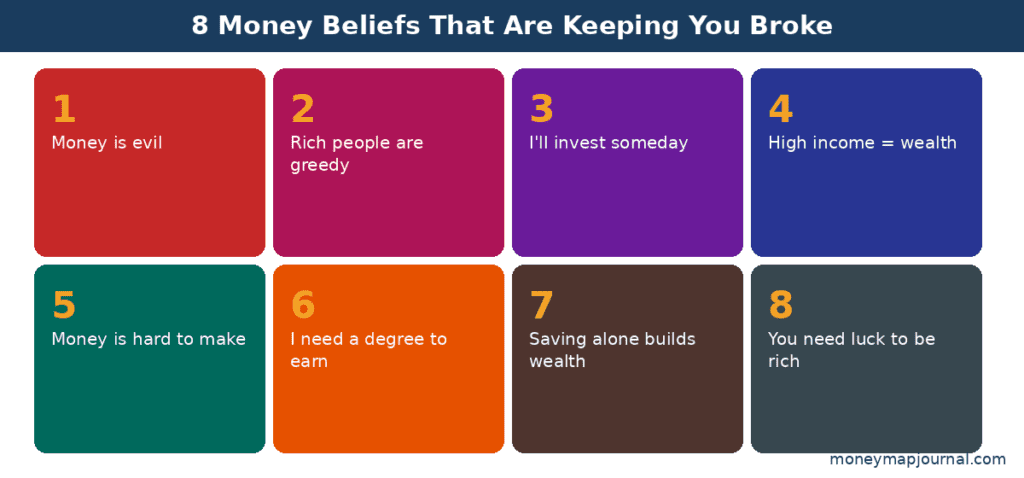
moneymapjournal.com | 8 money beliefs that silently sabotage your financial growth.
Belief #1: “Money Is the Root of All Evil”
This might be the single most destructive money belief in existence, and it is passed down through generations like a family heirloom. Somewhere along the way — from a sermon, a parent’s comment, or a cultural saying — many of us absorbed the idea that money is dirty, corrupting, or morally dangerous.
But let me ask you this: is a hammer evil? A hammer can build a home or break a window. The tool itself is neutral. Money is the same. It amplifies who you already are. In the hands of generous people, wealth creates schools, hospitals, and opportunities. In the wrong hands, yes, it can cause harm — but the problem is never the money itself.
The shift: Replace “money is evil” with “money is a tool — and I choose to use it for good.” This single reframe removes the subconscious guilt that makes wealth feel forbidden — and it is the first step toward a genuine wealth mindset.
Belief #2: “Rich People Are Greedy and Corrupt”
I used to believe this deeply. It felt almost righteous — like choosing to stay humble by refusing to admire or aspire to what wealthy people had. But what this belief was actually doing was preventing me from ever seeing myself in their position.
If you genuinely believe that becoming wealthy makes you a bad person, your subconscious will self-sabotage every time you get close. You’ll make excuses to spend instead of invest, dismiss opportunities as “too risky,” or downplay your own abilities.
The shift: A true wealth mindset separates character from net worth. Focus on the kind of wealthy person you want to become. Many of the world’s most generous people — philanthropists, social entrepreneurs, community builders — built that generosity on a foundation of financial success.
Belief #3: “I’ll Start Investing Someday”
“Someday” is one of the most expensive words in the English language, and it is the enemy of any real wealth mindset. Every year you delay investing is a year of compound interest you will never get back. The power of compound growth is not a theory — it is mathematics. A person who starts investing at 25 will, in most scenarios, build significantly more wealth than someone who starts at 40, even if the late starter invests more per month.
I covered this in depth in our guide on passive income ideas for beginners. The core message is the same: starting small and starting now always beats waiting for the perfect moment.
The shift: A wealth mindset removes the word “someday” from your financial vocabulary. Replace it with a date, a number, and a plan. Even investing a small amount each month builds the habit and the momentum that changes everything.
Belief #4: “A High Income Means I’m Wealthy”
This is one of the sneakiest beliefs on this list — and one the wealth mindset corrects quickly — because it feels so logical. If I earn a lot, I must be doing well financially — right? Not necessarily. Wealth is not what you earn. It is what you keep and grow.
History is full of high-earning professionals — athletes, executives, entertainers — who ended up broke within years of their peak income. Why? Because they confused income with wealth. They inflated their lifestyles to match every salary bump, leaving nothing to accumulate.
The shift: Measure wealth by net worth, not income. Ask yourself each month: “Did my net worth grow?” If your income is rising but your net worth is stagnant, you have a lifestyle inflation problem, not a success story. You can explore more about this in our article on what net worth is and how to grow it every year.
Belief #5: “Money Is Hard to Make”
When I was younger, I watched my parents work incredibly hard for modest pay. That image became my template for how money works — that earning it is always exhausting, always a struggle. It took me years to realise that this belief was closing my mind to entire categories of income.
Money does not only flow from a salary. It flows from skills, from creativity, from relationships, from assets you own and systems you build. The world has never offered more ways to generate income than it does right now — digital products, consulting, freelancing, investment returns, content creation, and more.
Our full breakdown of how to create multiple income streams starting from one job shows exactly how to begin this transition — without quitting your day job.
The shift: Replace “money is hard to make” with “there are many ways to create value, and I am open to learning them.” Curiosity is the wealth mindset in action — and it is the wealth-builder’s greatest asset.
Belief #6: “You Need More Education Before You Can Start”
Education is valuable. I am not here to dismiss it. But using the need for more knowledge as a reason to delay action is one of the most common forms of financial procrastination. People wait to get a degree before starting a business. They wait to finish a course before investing. They wait until they “fully understand” before making their first move.
The reality is that most financial education happens by doing, not by studying. The best investors learned by investing. The best entrepreneurs learned by starting. Knowledge supports action — it does not replace it.
The shift: The wealth mindset demands that you commit to learning and acting simultaneously. Read one book or article on personal finance per month, but also take one tangible financial step every month. Action accelerates learning faster than any course can.
Belief #7: “Saving Money Is Enough to Build Wealth”
Saving is essential — do not get me wrong. But saving alone is a losing strategy over the long term, and the wealth mindset knows the difference. Here’s why: inflation. Every year that your money sits idle in a low-interest account, its purchasing power slowly erodes. What costs a certain amount today will cost more in ten years, and your savings will buy less.
True wealth-building requires that your money work while you sleep. This means putting your savings into assets that grow: index funds, property, businesses, or other appreciating investments. Saving is the foundation; investing is the structure built on top of it.
The shift: A wealth mindset commits to the principle that every dollar saved should eventually be assigned a job: either growing in an investment or serving a specific short-term goal. Idle money is slowly dying money.
Belief #8: “You Need to Be Lucky to Get Rich”
I understand why people believe this. When you look at some of the world’s wealthiest people, it can seem like luck played a huge role — being born into the right family, launching a product at the right time, knowing the right person. And yes, luck sometimes plays a role.
But luck, as the saying goes, is what happens when preparation meets opportunity. The people who seem lucky are almost always the ones who showed up consistently, made sacrifices early, built skills over years, and were positioned to take advantage when an opportunity appeared. They created the conditions for luck.
The shift: The wealth mindset does not wait to be lucky. It starts doing the things that put you in luck’s path: building skills, expanding your network, investing in your financial education, and taking small consistent steps toward your goals every single week.
“Wealth is not about having a lot of money; it is about having a lot of options.” — Chris Rock
How to Rewire Your Money Beliefs: A Practical Framework
Understanding these beliefs intellectually is the easy part. Building a true wealth mindset takes real, deliberate practice. Here is a simple framework I use and recommend:
- Write your current beliefs down — unfiltered, honest, raw. You cannot change what you cannot see clearly.
- Challenge each belief with a question: “Where did this belief come from? Is it still true? Is it serving me?”
- Find evidence that contradicts the belief. Read about people from similar backgrounds who built wealth. Evidence is the most powerful belief-changer.
- Replace the belief with a specific, positive alternative — not a vague affirmation, but a practical conviction you can act on.
- Create accountability by sharing your financial goals with a trusted friend or mentor. Beliefs shift faster in community.
For the practical money habits that reinforce this mindset, visit our guide on how to negotiate your salary — the best financial decision you can make. What you earn sets the ceiling; what you believe determines how high you build.
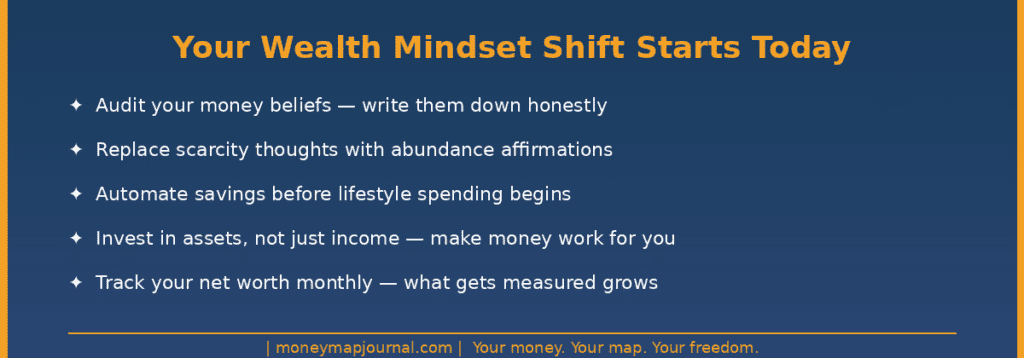
moneymapjournal.com | Your wealth mindset shift starts with five daily commitments.
What Research Says About Money Beliefs
Psychologists Drs. Brad and Ted Klontz developed the concept of “money scripts” — deeply held financial beliefs, usually formed in childhood, that drive adult financial behaviour. Their research at Kansas State University identified four core money belief patterns: money avoidance, money worship, money status, and money vigilance. Three of these four are statistically linked to lower net worth, lower income, and higher debt. This is not anecdotal — it is peer-reviewed. You can read more in their published work via Forbes — Are Your Money Beliefs Holding You Back?.
Another excellent resource for this shift is Raymond James — The Wealth Mindset: Shifting from Accumulation to Abundance, which outlines how successful entrepreneurs and executives make the transition from fear-based money management to strategic, purpose-driven wealth building.
Final Thoughts: Your Beliefs Are the Beginning
I want to end where we began — with honesty. Shifting your money mindset is not a weekend project. It is an ongoing, sometimes uncomfortable process of examining the beliefs that feel most natural to you and questioning whether they are actually true.
The 8 wealth mindset barriers we covered today — from “money is evil” to “I need to get lucky” — are not personal failures. They are learned patterns, passed down through culture, family, and experience. But learned patterns can be unlearned. New beliefs can be built. And with the right foundation, real, lasting wealth becomes not just possible but probable.
Start with one wealth mindset shift that resonated most with you today. Write it down. Question it. Replace it. Then take one financial action — however small — that reflects your new thinking. That is how the wealth mindset begins: one small, intentional shift at a time.
Explore more practical wealth-building strategies at moneymapjournal.com/category/building-wealth/ — because your money deserves a better map.
“The only thing standing between you and your financial goals is the story you keep telling yourself about why you can’t achieve them.” — Jordan Belfort