

Illustration: The paycheck-to-paycheck feeling — low balance, scattered notes, no cushion. You are not alone.
You work hard. You bring in a salary every month. And yet, a few days before payday, you find yourself watching your bank balance fall to nearly zero — again. If that sounds familiar, this article is for you.
First, the most important thing to know: you are not failing. Living paycheck to paycheck is one of the most common financial situations in the world. According to a 2025 PNC Bank survey, 67% of workers say they live paycheck to paycheck, up from 63% the year before. That number crosses all income levels. People earning $50,000, $100,000, and even more can find themselves trapped in the same cycle.
The cause is almost never laziness or carelessness. It is usually a combination of rising living costs, debt payments that eat into income, no emergency buffer, and nobody ever teaching us a clear system for managing money.
This guide is for that system — and it will show you exactly how to stop living paycheck to paycheck. Follow these six realistic steps — one at a time, in order — and you will begin to see breathing room in your budget. Not immediately, but steadily. And that is exactly how lasting change happens.
Step 1: Find Out Where Your Paycheck to Paycheck Money Is Actually Going
Before you can change anything, you need to see the full picture. Most people who live paycheck to paycheck have a rough idea of their big expenses — rent, transport, groceries — but are genuinely surprised by how much disappears on smaller, forgotten things.
For the next 30 days, track every single transaction. Every coffee, every mobile data top-up, every impulse purchase. You can use a free budgeting app, a spreadsheet, or a plain notebook. The tool does not matter — the habit does.
At the end of the month, sort your spending into three categories:
- Needs — rent or mortgage, utilities, groceries, transport, medical
- Wants — dining out, subscriptions, entertainment, shopping
- Debt payments — credit cards, loans, buy-now-pay-later
Most people are genuinely shocked at the wants category. Subscriptions alone — streaming services, apps, gym memberships you forgot about — can quietly drain $80 to $150 every month. This exercise is not about guilt. It is about clarity. You cannot fix a leak you cannot see.
Quick win: Cancel just one unused subscription this week. Even $10–$15 back in your pocket every month is $120–$180 per year.
Step 2: Build a Starter Emergency Fund of $1,000
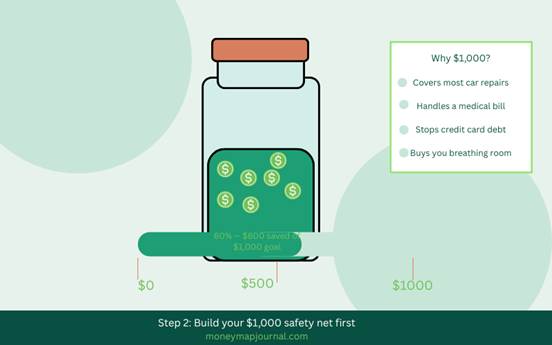
Illustration: Building your $1,000 emergency fund — the single most important step to break the cycle.
Here is the single biggest reason people stay stuck in the paycheck-to-paycheck cycle: no cushion. When the car breaks down, when the child gets sick, when a bill comes in higher than expected — there is nothing to absorb the shock. So they reach for a credit card, take on debt, and the cycle tightens.
Your first financial goal — before paying off debt aggressively, before investing — is to save $1,000 as a starter emergency fund. That single buffer will stop small surprises from becoming financial disasters.
How to get there faster:
- Set up an automatic transfer of even a small amount — $10, $20, $50 — every payday into a separate savings account
- Sell things you no longer use. Most households have $200–$500 worth of items sitting unused
- Put any unexpected income — a birthday gift, a tax refund, an overtime payment — straight into the fund
Keep this money in a separate account from your everyday spending. Out of sight, out of temptation. Once you hit $1,000, do not touch it unless it is a true emergency.
Parent tip: Frame this to yourself as a family safety net. Teaching your kids that surprises do not have to be crises is one of the most powerful money lessons they will ever learn.
Step 3: Build a Budget That Actually Works to Avoid Paycheck to Paycheck Living
The word budget makes a lot of people uncomfortable. It sounds like restriction. Like giving things up. But a budget is not a prison — it is a plan. It tells your money where to go, instead of wondering where it went.
The simplest framework for beginners is the 50/30/20 rule:
- 50% of your take-home income goes to needs — rent, food, transport, utilities
- 30% goes to wants — eating out, entertainment, hobbies
- 20% goes to savings and debt repayment
If 20% feels impossible right now, start with 5% or 10%. The percentage matters less than the habit. Even putting aside 5% of every paycheck, consistently, will build more financial stability than trying to save 30% for two months and giving up.
For more precision, try zero-based budgeting: assign every single dollar of your income a job before the month begins. Income minus all expenses, savings, and debt payments equals zero. Nothing sits unassigned — because unassigned money always gets spent.
Want to track your progress as you work through each step? I’ve put together a free Monthly Budget Tracker — it includes your income, expenses, subscription audit, and debt snowball all in one place. Download it below and fill it in as you read.
Step 4: Cut the Invisible Expenses (Without Feeling Deprived)
Once you have your budget in front of you, it is time to find the leaks. We are not talking about extreme frugality — no more coffee ever, no more going out. We are talking about the expenses you are paying for without thinking about them.
- Subscription creep — audit and cancel anything you have not touched in 60 days
- Lifestyle inflation — a raise is an opportunity to save more, not just spend more
- Convenience spending — delivery apps add 40–80% to the cost of a meal. Cooking at home three more times per week can save $200–$400 per month
- Bank fees and interest — if you carry credit card balances, interest charges alone could be costing you $50–$200 per month
The goal is not to remove all joy from your life. It is to make your spending intentional. Keep the things that genuinely matter to you. Cut the things you are paying for on autopilot.
Step 5: Attack Your Debt with a Clear Strategy
Debt is the heaviest chain in the paycheck-to-paycheck cycle. Every month, a portion of your income goes to interest — money that does not build anything for you. The faster you clear your debt, the more of your own income you keep.
The Debt Snowball
List all your debts, smallest to largest, by balance. Pay minimum payments on all, and throw every extra dollar at the smallest debt first. When it is gone, roll that payment into the next one. Early wins build powerful momentum.
The Debt Avalanche
List debts by interest rate, highest to lowest, and pay the highest-rate debt first. This saves the most money in interest over time. It is mathematically smarter but requires more patience since the first win may take longer.
Even an extra $20 per month on your smallest debt accelerates your payoff date. Do not wait until you have enough to start. Start with what you have.
Step 6: Look for Ways to Grow Your Income
Cutting expenses can only go so far. At some point, the most powerful lever you have is earning more. Even a small increase in monthly income — an extra $200 to $400 — can be enough to break the cycle completely.
For salaried professionals
- Negotiate your salary — employees who ask receive an average 5–7% bump. If you have been in your role 12+ months with no raise, the ask is overdue
- Develop one skill that commands higher pay — a certification, a course, a new tool in your field
For parents and those with limited time
- Freelance from existing skills — writing, design, bookkeeping, tutoring. Even 4–5 hours per week adds $250–$500 per month
- Sell unused household items — one good clear-out can bring in several hundred dollars
For young adults starting out
- Pick up one consistent side hustle — pet sitting, delivery, weekend shifts. $200 extra per month saved consistently becomes $2,400 in a year
- Ask for overtime — the fastest legal way to boost your monthly income right now
Pick one income opportunity, commit to it for 90 days, and see what it produces. Consistency beats hustle.
You Can Stop Living Paycheck to Paycheck — One Step at a Time
The paycheck to paycheck cycle can feel permanent — but it is a pattern, and patterns can be broken. Like the water is always at chin level and one bad week will pull you under. But it is not permanent. It is a pattern — and patterns can be changed.
Research consistently shows that most people can break the cycle within 3 to 6 months of consistent, small changes. You do not need a huge salary. You do not need perfect discipline. You need a system and the willingness to start.
So here is your first action step, right now:
- Open your banking app and look at last week’s spending
- Find one thing — just one — that you are paying for without thinking about it
- Cancel it, reduce it, or redirect that money to your starter emergency fund
That one step is the beginning. And every step after that gets a little easier.
Frequently Asked Questions About Living Paycheck to Paycheck
How long does it take to stop living paycheck to paycheck?
Most people begin to feel a difference within 1 to 3 months of consistent budgeting and cutting expenses. Breaking the cycle fully typically takes 6 to 18 months, depending on income and debt levels.
Can I save money if I am already on a very tight budget?
Yes — but start very small. Even $5 or $10 per week saved automatically is meaningful. The habit is more important than the amount in the early stages.
Should I pay off debt or build my emergency fund first?
Build your $1,000 starter emergency fund first. Then aggressively pay down debt. Without that initial buffer, every unexpected expense will send you back to borrowing, which undoes your debt repayment progress.
What if my income genuinely is not enough to cover my basics?
Look for any immediate income opportunities — overtime, a side job. Contact creditors to discuss reduced payment plans. Look into community or government assistance programmes if available in your country. You are not alone in this, and there is no shame in seeking help.